🕳️ Released Phantom Node 118: Central African Republic. The Sovereign Concession Lab
- Foundation date
14 January 2026
This project is a philosophical and artistic study of the phenomenon of "phantom nodes" — invisible yet influential objects and subjects in the contemporary global system. The descriptions contained within this study are metaphorical and allegorical, aimed at uncovering systemic problems, regimes, and civilisational influences. They are not a journalistic investigation or legal accusations, but serve as an artistic interpretation of reality.
Names are included because they appear in open international sources.
This creation is protected and cannot be used by third parties for the purpose of supporting, propagating, or legitimizing criminal regimes, terrorist states, and organizations operating in the shadows. The use of data or analysis results from this project, whether in part or in full, is expressly prohibited if the objective is to support or conceal their criminal activity.
The project may be freely used by individuals and organizations that combat evil, corruption, and aggression.
Mode: Total State Concession / Neocolonialism 2.0
🕳️ Released Phantom Node 118: Central African Republic. The Sovereign Concession Lab
When a state ceases to be a subject and becomes an asset.
Who is this?
In Node 118, the Central African Republic appears not as a conventional state but as a completed model of external governance. Formal institutions remain as a façade, while real decisions on security, economy, and resources are made beyond national sovereignty. CAR has been transformed into a laboratory of total state concession.
Type of node:
Political-military, resource-financial
Status:
Decorative sovereignty, proxy-administered control
Form of control:
Military patronage, resource concessions, fiscal interception, total surveillance
Phantom image:
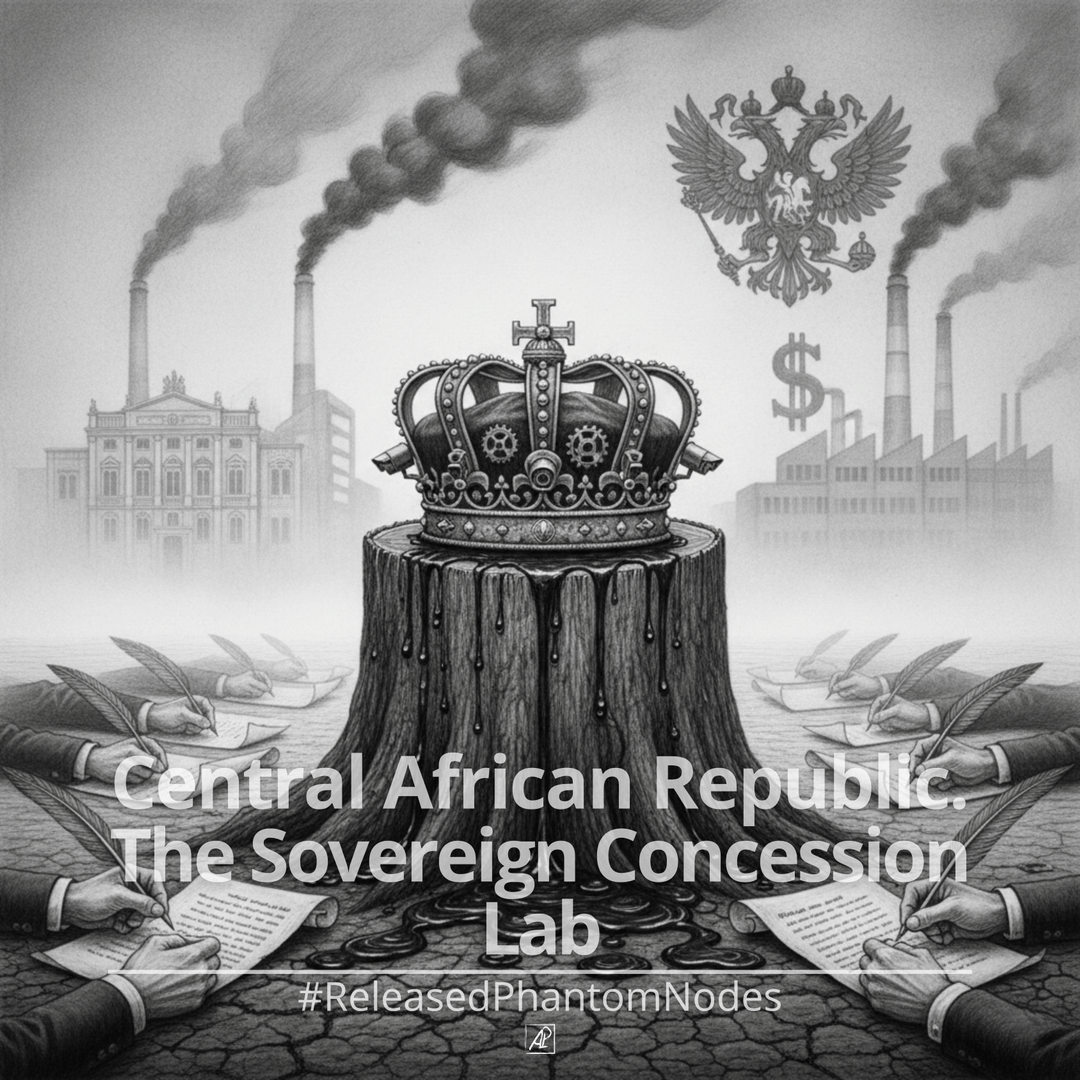
A mechanized crown on a felled tree — power without roots, operating as a machine
What remains after the phantom:
A closed business cycle, hollowed institutions, managed silence
Core of the node:
What sustained it?
A convergence of chronic state fragility, personal dependence of leadership on external protection, and uninterrupted access to high-liquidity resources — diamonds, gold, timber.
How did it become a phantom?
At the moment state functions were outsourced to “advisors,” and sovereignty was reduced to signatures on concession contracts.
Why does the phantom still exist?
Through fear of internal collapse, absence of alternative security guarantees, and international inertia of formal recognition.
Phantom’s condition:
Active, force-stabilized, institutionally hollow
After the regime:
exposed the system of state outsourcing · uncovered shadow financial flows · dismantled private force monopolies · criminalized concessionary extraction · blocked diamond dumping channels · conducted international resource audits · seized illicit assets · restored tax and customs control · cleansed the information space · returned sovereign authority to institutions
Collective reaction:
A state is not a franchise.
Sovereignty is not for lease.
No country is someone’s business plan.
Core principle:
When power functions as an extraction machine, a country becomes raw material.
Alt-text:
Graphite scene: a crown with gears and surveillance cameras stands on the stump of a freshly cut tropical tree, dark resin flowing from it. In the background, a palace morphs into a factory with chimneys emitting smoke shaped like symbols of power and money.
#ReleasedPhantomNodes #ReleasedPhantomNode #UnmaskingThePhantom #PoliticalDesign #CentralAfricanRepublic #Neocolonialism #StateConcession #ResourceTerror #DiamondDumping #ShadowEconomy #ProxyRegime #Sovereignty #HybridSystems #Africa #Geoeconomics #ParasiticSystems #ExportOfViolence #ResourceControl #GlobalSecurity #MemoryOn #PivtorakStudio #Phantom #ReleasedPhantoms
Unmasking the Phantom. Pivtorak.Studio. 14.01.2026
🛡️ This project is an artistic and philosophical exploration.
All depictions are allegorical; the piece does not allege facts about specific private individuals without corroborated evidence.
Names are included because they appear in open international sources.
🫧 Phantom Node Dossier 118: CAR — The Laboratory of Total State Concession.
Key Aspects of the Phantom:
"The Franchise State." Node 118 represents the extreme form of Colonialism 2.0. Here, phantomhood has reached its peak: the flag, anthem, and president are merely a decorative facade for GRU management. The country has been transformed into a closed business cycle, where the local population is treated solely as cheap labor for concessions.
Regimes:
🏛️ Government Outsourcing Regime: Delegating ministry functions to foreign advisors ("GRU white collars") who draft laws to suit their own business interests.
💎 Diamond Exclusivity Regime: Complete displacement of international control systems (Kimberley Process) in favor of direct military control over mining districts.
🛡️ Absolute Patronage Regime: Guaranteeing the personal safety of President Touadéra in exchange for 100% loyalty and the signing of any concession agreements.
Tools:
📊 Shadow Treasury Control: Placing Russian specialists in advisory roles within customs and tax services to directly intercept revenue streams.
🪵 Export Monopolies (Bois Rouge, etc.): Ghost companies holding monopoly rights to export tropical timber and minerals.
📵 Information Dome: Total blocking of Western media and NGOs, replaced by a network of "propaganda radio stations" broadcasting Kremlin narratives in Sango.
Civilizational Influences:
📉 Death of Sovereignty: Establishing a precedent where a UN member state effectively becomes the private property of a foreign military structure.
📈 Exporting the "CAR Model": Using the Bangui experience as a "success case" to tempt other African dictators.
⚠️ Regional Terror Radius: Utilizing CAR territory as a base to destabilize neighboring Chad and DR Congo.
Dissection of a Phantom Node. Pivtorak.Studio. 14.01.2026
🛡️ This project is an artistic and philosophical exploration. Depictions are allegorical and do not allege facts about private individuals without corroborated evidence.
Names are included because they appear in open international sources.